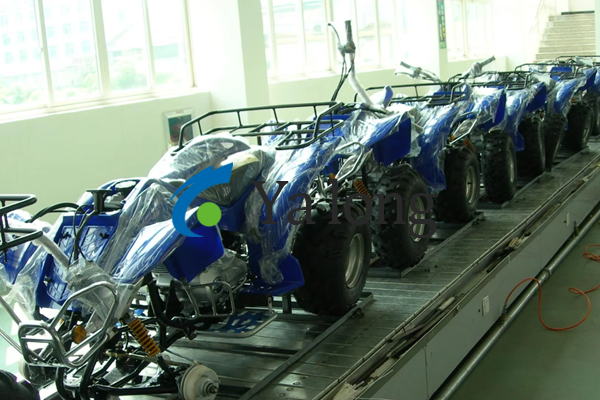
Mountain bike delivery line: efficient logistics engine for outdoor cycling equipment manufacturing
Due to its complex structure and diverse components (heavy parts such as frame, suspension, and wheel sets + precision parts such as transmission and brakes), mountain bikes have extremely high requirements for heavy-load compatibility, flexible adaptability, and precision protection of the transmission line. The following focuses on the entire mountain bike production process to create a professional transportation solution:
1. Adapting core transmission modules to scenarios
The heavy-duty roller track carries the frame after being welded, painted and transferred. It is suitable for a 20 - 30kg mountain bike frame. The roller spacing accurately matches the frame size. With the jacking and moving mechanism, the frame is turned 90 °/180 ° butt welding and polishing process, with a positioning error of ≤ 3 mm.
The anti-static belt line is responsible for transporting precision parts such as transmission kits and brake components. It adopts anti-static PU belts and has flexible limit grooves on the surface to avoid collision and scratching of parts; it integrates a visual recognition system to automatically sort different specifications of transmission levers, and the error rate is <0.1%.
The AGV intelligent transfer vehicle is responsible for the transfer of the whole vehicle after pre-installation (the weight of the whole vehicle including wheel sets and suspension suspensions reaches 40 - 50 kg). It uses laser SLAM navigation to automatically plan the optimal path to avoid personnel and equipment in the production area; it supports multiple vehicle models (Hard-tailed, full-suspension mountain bike) mixed lines, scan code to switch tooling, and complete model adaptation in 3 minutes.
2. Core values: solving the three major pain points in mountain bike production
The multi-component collaboration problem ranges from frame manufacturing to vehicle assembly, with 10 + processes in series. Through the flexible connection of "roller line + belt line + AGV", the process waiting time is shortened by 40%, and the average daily transportation of mountain bike parts/vehicle is 300 - 500 sets.
Precision parts are designed to protect pain points with anti-static and anti-bump designs. The appearance defect rate of precision parts (such as oil disc brakes and electronic transmission) has dropped from the industry average of 5% to 0.5%, ensuring the reputation of durability of outdoor riding equipment.
Customized production needs support flexible switching between small batch customization (such as personalized painted frames and special shock absorber configurations) and mass production, and the order delivery cycle is reduced by 30%, adapting to the trend of "multiple varieties and fast delivery" in the outdoor equipment market.
3. Industry adaptation and extension
It not only covers professional mountain bikes (XC, AM, DH models), but also expands to the production of urban commuter bicycles and electric-assisted mountain bikes. Through modular transformation, it meets the logistics needs of all categories and full-process cycling equipment manufacturers.