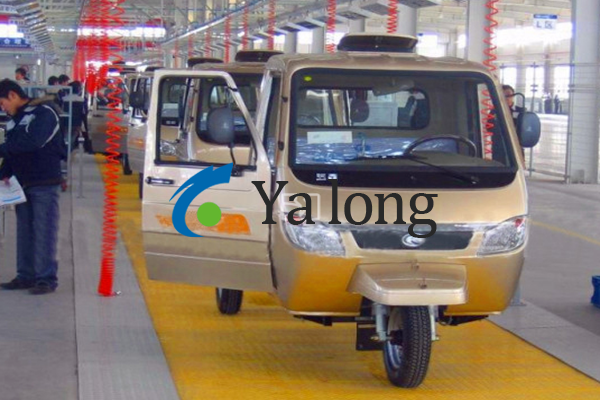
Tricycle conveying line: the flexible transfer core of lightweight transportation vehicle manufacturing
The tricycle conveying line is an efficient logistics system customized for the characteristics of short-distance transportation tricycles. It focuses on the three cores of "flexible adaptation, smooth transfer, and economy and practicality". It integrates adjustable roller tables, light suspension chains, intelligent sorting lines and other equipment, covering the entire production chain from parts distribution, frame assembly to vehicle debugging, and perfectly meets the manufacturing needs of multiple types of tricycles such as fuel/electric, freight/passenger transport, etc. It is a key facility to balance production efficiency and cost control.
1. Core transportation configuration and scenario application
Adjustable light roller table line: Designed for tricycle frames (weight ≤300kg), the width of the roller table can be electrically adjusted (adapted to the wheelbase of 1.2-1.8m), and it can be used with pneumatic locking device to achieve precise positioning of ±3mm, support welding, and chassis assembly and other core processes. Lightweight suspension conveyor chain: Responsible for the transfer of light-loaded parts such as cab shells and plastic parts. It adopts flexible suspension design to avoid bumps and scratches of parts, save ground space, and adapt to the layout of small and medium-sized workshops. Intelligent sorting and transportation line: Connect parts storage and assembly stations, identify different vehicle types of accessories (such as freight cars and passenger seats) through scanning code, automatically allocate transportation paths, and the sorting error rate is <0.1%.
2. Core advantages
Strong flexibility and adaptability: Support mixed-line production of multi-specification tricycles. By quickly replacing positioning fixtures and adjusting parameters, model switching can be completed within 15 minutes, meeting the dual needs of small batch customization and large-scale mass production. More stable transfer: In view of the simple structure of the tricycle but high assembly precision requirements, the transfer equipment runs smoothly and without vibration, and the defective transfer rate of core components is controlled within 0.2%. Low cost and high adaptability: The equipment adopts modular design, has short installation cycle and low maintenance costs. It can be put into use without large-scale renovation of the workshop, and is especially suitable for the capacity upgrade needs of small and medium-sized tricycle manufacturers.
3. Industry value
Through seamless connection of processes, the transmission line upgrades the traditional manual-led transfer mode to automated circulation. It not only reduces manual handling links by 80%, but also increases the production rhythm by 40%. A single production line can support the daily transfer demand of 150-200 tricycles. At the same time, its flexible adaptation and low-cost advantages allow small and medium-sized enterprises to achieve large-scale production without high investment, providing strong support for the standardized and efficient development of the short-distance transportation industry